
San Francisco ERISA Disability Lawyer
Trusted disability insurance attorneys serving San Francisco and the surrounding area, with more than 30 years of experience holding insurers accountable.
If your long-term disability claim has been denied under a plan you get through your employer, the path to payment runs through a federal appeal process, not a standard lawsuit. Our San Francisco, CA ERISA disability lawyer at The Law Office of Bennett M. Cohen can review what the insurer decided, find the gaps in its reasoning, and assemble the evidence your claim needs before any deadline passes. We offer a free consultation to talk through where your claim stands, so contact us today.
ERISA Disability Lawyer San Francisco, CA
 What does an ERISA disability lawyer do? ERISA (the Employee Retirement Income Security Act of 1974) is the federal law that governs most long-term disability plans offered through an employer, and it controls how a claim is filed, denied, and appealed. When an insurer denies your claim under an employer-sponsored plan, you are not dealing with a standard insurance dispute under California law. You are operating inside a federal system with its own procedures, its own deadlines, and its own strict limits on what a court will consider.
An attorney handling these matters reviews the plan language, the denial letter, and the medical file, then works to fix the problems before the case reaches a courtroom. Much of the result is decided during the administrative appeal, because federal judges generally limit their review to the record built at that stage. What goes into the appeal record is what the court will see, which is why having experienced counsel before that window closes can shape everything that follows.
We work with claimants in San Francisco and across California to build that record correctly from the start. That means gathering updated medical documentation, securing detailed statements from treating physicians that tie a diagnosis to specific functional limitations, and identifying the gaps in the insurer’s own reasoning. The Law Office of Bennett M. Cohen has represented people against some of the largest disability insurers in the country for more than 30 years, and we understand how to effectively build a case to support our clients.

Types of ERISA Disability Cases We Handle in San Francisco
 Disability denials come in many forms, and the reason an insurer puts in writing rarely tells the whole story. We represent San Francisco claimants across a range of conditions and policy types, including employer plans governed by ERISA and individual policies governed by California law. The matters below are the ones we handle most often.
- Long-term disability denials. Group long-term disability is where ERISA most often applies. We review the plan’s definition of disability, the insurer’s internal medical reviews, and the common insurer tactics used to justify a denial.
- Disability appeals. Most plans require an administrative appeal before you can sue. Because courts generally review only the appeal record, we treat this stage as the place to add the medical and vocational evidence the insurer left out.
- Disability insurance claim denials. We challenge denials issued at the first review, whether the insurer says your condition is not severe or that you can perform some other job. Each stated reason gets answered with records.
- Individual disability claims. Policies bought outside of work are governed by California law rather than ERISA, which can open the door to a bad faith insurance claim when an insurer acts unreasonably.
- Chronic pain and fibromyalgia claims. Insurers often deny conditions that lack a clear test result. We document how chronic pain limits your daily function and connect it to your work restrictions.
- Mental health condition claims. Depression, anxiety, and similar diagnoses are frequently subject to shorter benefit periods and heightened scrutiny. We gather treatment records and provider statements that support the limitation.
- Surveillance and exam-based denials. Some insurers rely on surveillance footage or a one-time medical exam to argue you can work. We show the full picture instead of a single afternoon.
- Disability buyout offers. When an insurer proposes a lump sum to close your file, the number is rarely the value of your future benefits. We weigh the offer before you decide on taking a buyout.
Why Choose The Law Office of Bennett M. Cohen as my ERISA Disability Lawyer in San Francisco, CA?
 Experience Against Major Insurers
 Experience Against Major Insurers
Our founder, Bennett M. Cohen, has represented plaintiffs against some of the most powerful corporate defendants in the country, including national life and disability insurers. He earned his undergraduate degree from Oberlin College and his law degree from the University of San Francisco School of Law. With more than 30 years of practice, he understands how these companies assemble a denial and how to take it apart.
Results and a Focus on Disability Claims
We have reversed insurance denials, secured payment of all past-due benefits, and won jury awards in disability bad faith matters. A disability benefits lawyer from The Law Office of Bennett M. Cohen can take a claim from the first filing through federal court. We offer a free consultation to review your denial and tell you where things stand.
San Francisco ERISA Disability Infographic
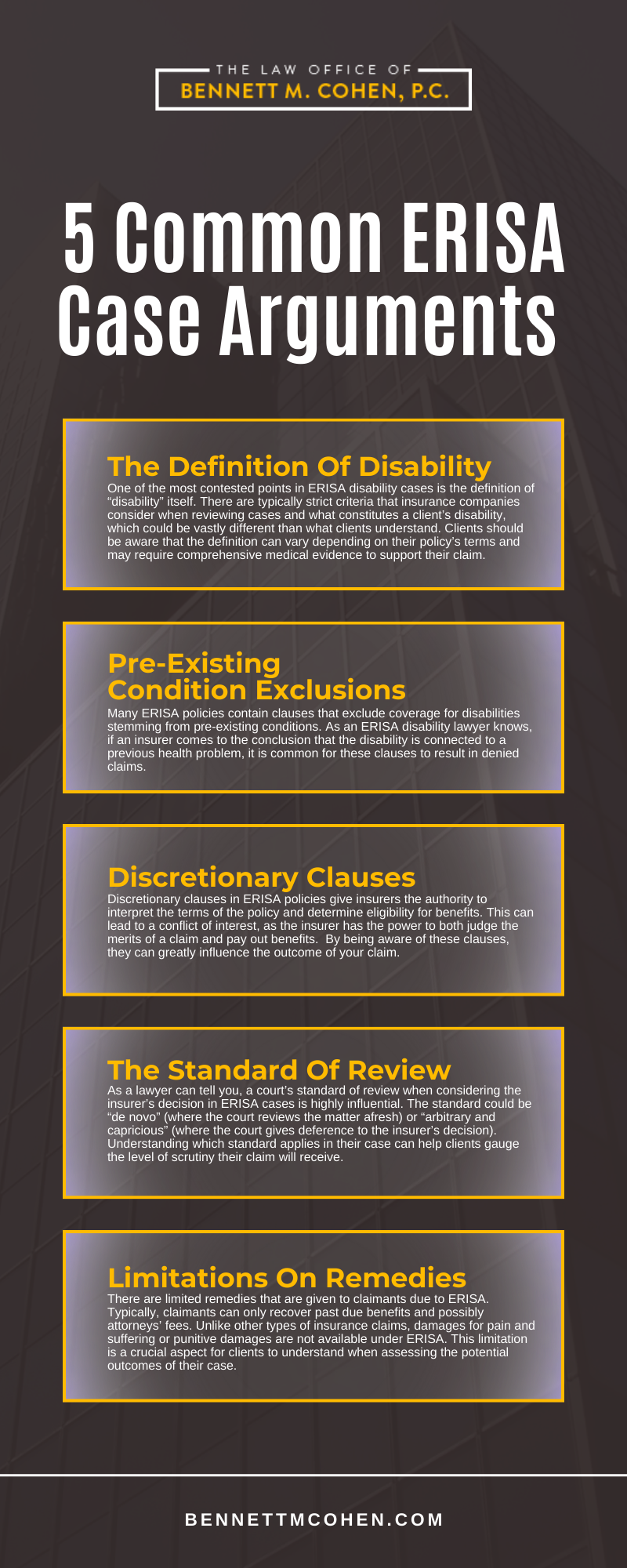
Understanding ERISA Disability Cases
Benefits, Denials, and Appeals in ERISA Disability Cases
 Benefits, Denials, and Appeals in ERISA Disability Cases
A handful of terms come up in almost every case. Knowing them helps you read your own paperwork.
- Disability. Plans usually define it as the inability to perform your own occupation, then later, any occupation. The wording controls what you must prove.
- The administrative record. This is the file the insurer compiles. In court, it is often the only evidence a judge will consider.
- The appeal. A required step after a denial, and in most cases the last chance to add evidence.
- Standard of review. Plan language can decide whether a judge looks at your claim fresh or defers to the insurer’s standard of review.
- Remedies. When ERISA applies, recovery is generally limited to the benefits owed, unlike a claim brought under state law.
What Are Important Aspects of an ERISA Disability Case?
The strength of an ERISA claim usually comes down to the record and the deadlines. A few aspects carry more weight than the rest.
- Medical proof that ties your diagnosis to specific work restrictions, supported by objective medical evidence where it exists.
- A clear account of your job duties, since the insurer must measure your limits against real demands.
- A written denial that states each reason, because the insurer generally cannot explain its denial with new rationales later in court.
- Attention to every appeal deadline, because a missed date can end the claim for good.
What Is The ERISA Disability Case Timeline?
Every plan runs on its own schedule, but the sequence stays consistent. Here is the general path a claim follows:
- You file the claim and submit your medical support.
- The insurer reviews the claim and issues a written decision.
- If it is denied, you file an administrative appeal within the plan’s window.
- The insurer reviews the appeal and either pays the benefits or upholds the denial.
- If the denial stands, the next step is a lawsuit in federal court.
What Should You Bring to Your ERISA Disability Consultation?
Bring whatever the insurer has sent you, along with your medical history. These documents let us assess the claim quickly and accurately.
- Your denial letter and any appeal deadlines stated in it.
- The plan documents or summary plan description.
- Recent medical records and your treating providers’ contact information.
- Pay stubs or employment records that describe your job duties.
During the consultation, we review where the claim stands and explain the options in plain terms. There is no cost for this first meeting.
What Are Important California Legal Resources for ERISA Disability Cases?
 ERISA is a federal law, so many of the rules that decide a disability appeal come from federal agencies rather than the state. The resources below are starting points for reading the rules that may apply to your situation.
- The U.S. Department of Labor explains the claim and appeal rights that apply to employer-sponsored disability plans.
- The Social Security Administration covers disability benefits that are separate from a private long-term disability claim.
- The California Department of Insurance handles complaints about individual policies and other insurance the state regulates.
Reach Out to The Law Office of Bennett M. Cohen to Schedule a Consultation
If a disability insurer has denied your claim, contact us to schedule a free consultation with our San Francisco ERISA disability attorney. Denials can feel final, but in most cases they are the beginning of a process, not the end of one. We will look at the denial letter, walk through your options, and give you an honest read on whether an appeal is worth pursuing. If the insurer relied on a paper review, a surveillance report, or a definition of disability that does not match your actual condition, we will identify it and flag any approaching deadlines so nothing is lost to a missed date.
ERISA Disability Statistics in San Francisco, CA
 Disability affects more working households than most people assume. More than one in four U.S. adults, about 27 percent, has a disability, based on CDC data. Coverage that replaces lost income, though, is not nearly as common. In a recent federal survey, only about 34 percent of private-industry workers had access to long-term disability insurance through an employer, according to BLS figures. For a San Francisco worker who does carry group coverage, approval is still far from automatic. When a carrier denies a claim under an employer plan, ERISA sets the rules for the appeal, and there is little room to recover from a misstep. That is where an ERISA disability lawyer in San Francisco, CA earns their keep.
Mistakes That Can Damage Your ERISA Disability Claim
 A denial is not the end of a long-term disability claim, but a few avoidable errors can weaken it before an appeal is filed. Because a federal judge usually reviews only the record built during the administrative process, early mistakes tend to follow the case to court. These are the ones we see most often among San Francisco claimants.
- Missing the appeal deadline. After a denial, federal rules give claimants at least 180 days to file an administrative appeal, and many plans set the deadline right at that mark. Miss it, and a court can refuse to hear the case for failure to exhaust the plan’s process. Calendar the date the moment a denial letter arrives. Federal Register
- Treating the appeal as a formality. Some claimants send a short note saying they disagree, then wait. The insurer generally has about 45 days to decide, and once it does, the record can close. The appeal is the time to add every supporting record, not a placeholder before a lawsuit.
- Leaving gaps in the medical file. Insurers routinely cherry-pick medical records to highlight one normal test result and set the rest aside. Updated records and a treating physician’s statement that ties the diagnosis to specific work restrictions carry far more weight than a diagnosis alone.
- Underestimating surveillance and social media. A short video clip or a single upbeat post can be pulled out of context to argue you can work. Keep your account of your limitations consistent with what your providers document.
- Returning to work too soon without documentation. A failed attempt to return to work does not automatically end a claim, and a genuine effort that does not last can still support disability when it is recorded properly. Rushing back without medical guidance, though, hands the insurer an argument.
- Standing alone against a vocational review. Carriers often hire a vocational consultant to claim you can perform some other occupation. Answering that opinion takes evidence of your real job duties and functional limits, not just your own description.
- Waiting until the record is closed to get help. The strongest time to involve a lawyer is during the 180-day window, while evidence can still be added. Claimants who appeal a denied claim on their own sometimes learn the hard way that the appeal, not the lawsuit, was the real trial. If your benefits were denied, you still have room to fight a denial before the deadline runs.
San Francisco ERISA Disability Lawyer FAQs
 Answers to the questions we hear most from San Francisco ERISA disability claimants.
How much does it cost to hire a San Francisco ERISA disability attorney?
The first consultation with our office is free. We review your denial letter and plan documents and give you an honest read on the claim before you commit to anything. We know money is tight when a paycheck has stopped, so this review is meant to help you decide your next step. If we move forward together, we explain any costs clearly and in writing at the outset.
What is ERISA, and does it apply to my claim?
ERISA is the federal law that governs most disability plans offered through an employer. If you received your coverage as a workplace benefit rather than buying it yourself, your claim is almost certainly an ERISA matter, which changes the deadlines, the evidence rules, and where any lawsuit is filed. Policies you buy on your own are usually governed by California law and can follow a different path.
How long do I have to appeal an ERISA disability denial?
Federal rules give you at least 180 days from the date you receive the denial to file your administrative appeal. Some plans allow longer, but many hold the line at 180 days, so read your denial letter closely. This window is the most important deadline in the process, because it is usually your last chance to add evidence to the record a court will review.
Should I appeal or file a lawsuit first?
In nearly all ERISA cases, you must complete the plan’s appeal before you can sue. Courts call this exhausting your administrative remedies, and skipping it usually means a judge will not hear the case. That is why we treat the appeal as the stage where a claim is won or lost, not a box to check on the way to court.
What are common mistakes people make when filing?
The most damaging errors are missing the appeal deadline and sending a thin appeal with little medical support. We also see claimants overlook their own job duties, which the insurer must weigh against their limits. Reviewing the common filing mistakes in disability claims helps, but the safest step is to get the record right before the plan closes it.
What does “disability” mean under my plan?
Most plans first ask whether you can perform your own occupation, then later switch to a stricter any-occupation standard. The exact wording controls what you must prove, so two people with the same diagnosis can reach different results. Understanding how your plan defines total disability is often the difference between an approval and a denial.
Can the insurer deny my claim if there is no objective test?
Insurers frequently deny conditions that do not show up on a scan or lab result, such as chronic pain, migraines, fatigue-based illnesses, or long-haul COVID. That does not mean the claim is weak. Detailed treatment histories, consistent provider notes, and functional evidence can carry a claim, and an insurer must explain the medical evidence it used to reject you.
Can the insurance company use reasons in court it never gave me?
Generally, no. An insurer is expected to state each reason for its decision in the denial, and it usually cannot raise new defenses later in litigation that it left out of its letters. That is one reason a clear, complete denial letter matters, and why we read yours line by line. Anything the insurer failed to explain can become a weakness in its position.
What if my benefits were paid and then cut off?
A termination of benefits is treated much like an initial denial, and the same appeal rights and deadlines apply. Insurers often stop payments after a paper review, a surveillance report, or a shift to the any-occupation standard. If your payments stopped, treat it like a denied claim and act quickly, because current medical and vocational evidence can challenge the decision.
Why do disability benefits sometimes get delayed instead of denied?
Delay can be its own tactic. Repeated record requests, slow medical reviews, and shifting explanations can push a claim toward a deadline or wear a claimant down. Knowing the errors that delay disability benefits helps you keep the file moving. If a carrier keeps changing the goalposts, that pattern can matter in an appeal, so document each contact.
Local Information for San Francisco ERISA Disability Cases
Where San Francisco ERISA Disability Lawsuits Are Filed
 Where San Francisco ERISA Disability Lawsuits Are Filed
Because ERISA is federal, a lawsuit over a denied employer-plan claim does not go to state court. For San Francisco claimants, it is filed in the United States District Court for the Northern District of California, whose main courthouse sits on Golden Gate Avenue. These cases look different from a typical trial. There is usually no jury, and the judge generally decides on the written administrative record rather than live testimony, which is why the evidence gathered during the appeal carries so much weight.
What Are Important Local Resources for San Francisco ERISA Disability Cases?
The offices below can help San Francisco residents understand their rights, file a complaint, or locate the court where an ERISA claim is heard. We share them for convenience only.
- United States District Court, Northern District of California — 415-522-2000. The federal court where San Francisco ERISA disability lawsuits are heard.
- U.S. Department of Labor, Employee Benefits Security Administration — 415-625-2481. The San Francisco office of the agency that oversees employer benefit plans under ERISA.
- California Department of Insurance — 1-800-927-4357. The state agency that handles complaints about individual policies and other insurance it regulates.
The Law Office of Bennett M. Cohen is not affiliated with, endorsed by, or sponsored by any of the organizations listed above, and we do not guarantee the services they provide.
About The Law Office of Bennett M. Cohen
Our founder, Bennett M. Cohen, has spent his career on the plaintiff’s side, and he personally handles each disability matter our office takes on rather than passing it to junior staff. Early on, he trained under a trial lawyer who once held one of the highest jury verdicts in the country, and that background shapes how he prepares a claim. Among our disability results is a confidential settlement that secured benefits for a claimant after an insurer had denied the claim.
What Our Clients Say
★★★★★
Bennett took on my long-term disability case for what ended up being diagnosed as Chronic Fatigue Syndrome. CFS cases aren’t always easy to get insurance companies to accept, but he made every effort to strengthen my case, which ended up being accepted by my insurance company!
“I felt he really cared about getting a good outcome for me. He was easy to work with and I enjoyed our conversations, which were very informative.”
Read more reviews on our Google Business Profile.
Contact The Law Office of Bennett M. Cohen
 If a disability insurer has denied or cut off your benefits, the appeal window is the time to act, and a San Francisco ERISA disability attorney can help you use it well. Our office reviews your denial letter and plan documents, identifies the gaps the insurer left, and builds the record your claim needs. The first consultation is free, and we will give you a straight answer about whether an appeal is worth pursuing. We return calls promptly and explain each step in plain terms. Contact us to schedule your free case review.
The Law Office of Bennett M. Cohen – San Francisco ERISA Disability Lawyers
1438 Market St, San Francisco, CA 94102
Meet Bennett M. Cohen
San Francisco Personal Injury Attorney
Bennett M. Cohen brings over 30 years of litigation experience which includes representing plaintiffs against massive companies like the Shell Oil Company, Standard Insurance Company, and Metropolitan Life Insurance Company. Bennett M. Cohen brings an experienced and dynamic touch that separates himself from large law firms. He can oversee every aspect of your case, ensuring you receive specialized assistance.
Learn more
Don’t Leave Your Case To Chance
Ensure your case is in the hands of a seasoned professional that will fight for you