
San Francisco Insurance Policy Lawyer
Are you looking for an insurance policy lawyer in San Francisco, CA?
Insurance policy representation guided by more than 30 years of experience in San Francisco and the surrounding area.
If an insurance company has denied, delayed, or underpaid a claim on a policy you hold, you can challenge that decision with a San Francisco, CA insurance policy lawyer. At The Law Office of Bennett M. Cohen, we represent policyholders across San Francisco who paid their premiums and then met resistance when they filed a claim. Founder Bennett M. Cohen has practiced for more than 30 years and has taken on some of the largest insurers in the country. Reach out for a free consultation to talk through your policy and your options.
Insurance Policy Lawyer San Francisco, CA
An insurance policy lawyer represents the policyholder, not the insurer. When you buy coverage, the insurance company promises to pay valid claims and to handle them fairly. Sometimes it does not. A denial letter arrives, or a payment stops, or the review drags on with request after request for more documents. Our San Francisco insurance policy attorneys read the policy language, examine the claim file, and press the insurer to honor the contract. That work can mean an internal appeal, a written demand, or a lawsuit for benefits and bad faith. The aim is the coverage you were promised and paid for. Policyholders reach us at different points. Some have a fresh denial letter and want to respond the right way. Others appealed on their own, hit a wall, and need someone to take the claim to court. We meet the claim where it stands.
Types of Insurance Policy Cases We Handle in San Francisco
 Insurance disputes take many forms, but they share a pattern. The insurer has money, time, and a claims department built to limit payouts. We handle the following matters for San Francisco policyholders.
- Denied insurance claims. A denial is not the last word. We review the reason the insurer gave, measure it against the policy, and build the record needed to reverse it. Many denials rest on thin grounds that do not survive a close look.
- Bad faith insurance. An insurer that withholds benefits without a reasonable basis may owe more than the unpaid claim. We pursue companies that delay, lowball, or deny in ways that ignore the policyholder’s rights. These cases can reach damages beyond the value of the original claim. California treats this conduct seriously, because an insurer holds power that a single policyholder does not.
- Delayed insurance payments. Some insurers do not deny a claim outright but let it sit for months. We push back when a company stalls on a valid claim, requests the same records twice, or lets a decision drift with no explanation.
- Disability insurance claim denial. Disability benefits replace income when illness or injury keeps you from working. Insurers often dispute whether a condition is truly disabling. These claims usually depend on medical evidence and the exact wording of the policy’s definition of disability. We handle both individual policies and group plans, and we know the tactics used to cut these claims short.
- Health insurance coverage dispute. When a health insurer refuses to cover treatment your doctor ordered, the fight is usually about the fine print. We challenge denials based on medical necessity, policy exclusions, and network arguments.
- Life insurance claim denial. A life insurer may deny a beneficiary’s claim over an application question, a lapse, or a contestability period. We represent beneficiaries who were counting on those funds after losing someone.
- Property and business insurance. Fire, water, theft, and business interruption claims often become disputes over cause and value. For a business, a slow or short payment can stall payroll and operations. We represent owners when the insurer’s number does not match the loss.
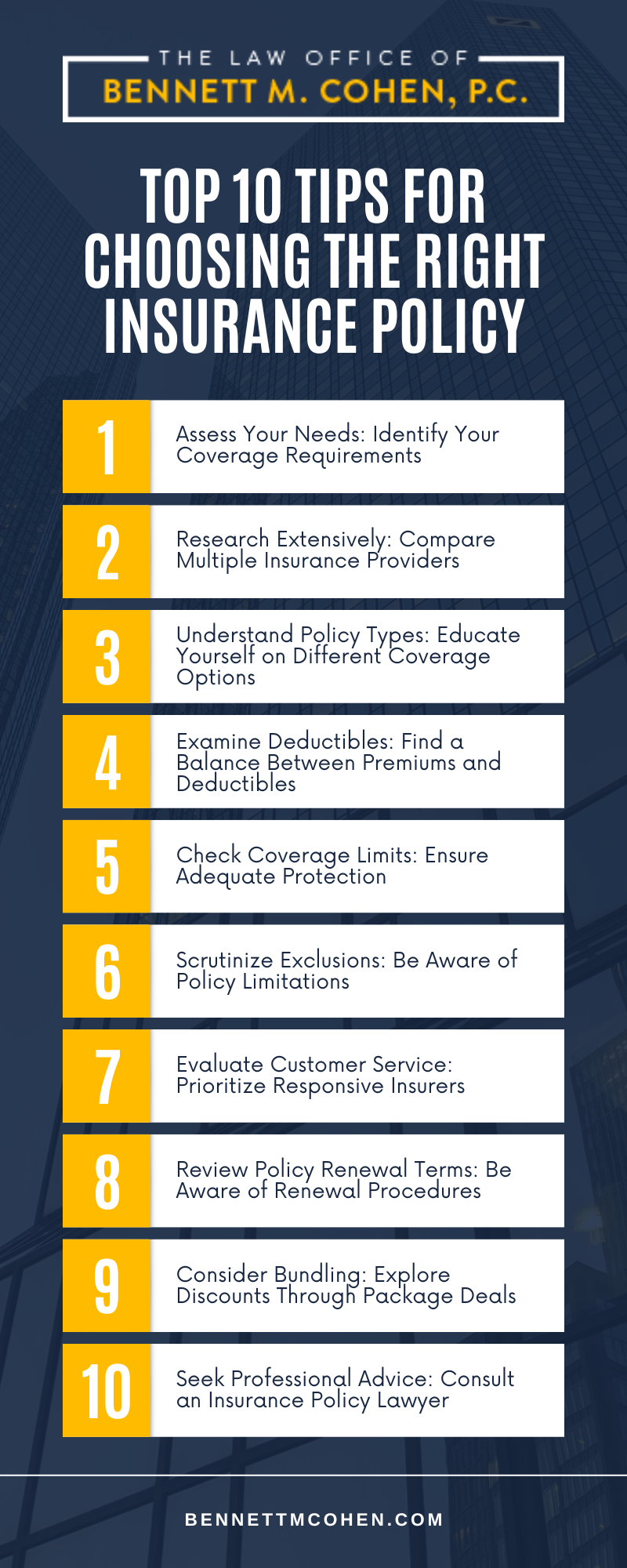
San Francisco Insurance Policy Infographic
Why Choose The Law Office of Bennett M. Cohen as my Insurance Policy Lawyer in San Francisco, CA?
 More Than 30 Years Against Major Insurers
 More Than 30 Years Against Major Insurers
Our founder, Bennett M. Cohen, has represented plaintiffs for more than three decades against some of the wealthiest corporate defendants in the country, including Metropolitan Life Insurance Company and Standard Insurance Company. He studied at Oberlin College and earned his law degree from the University of San Francisco School of Law. When you reach out to us for support from an insurance litigation lawyer in San Francisco, CA, we’ll read policies closely. We know how carriers build a denial, and we prepare each claim as though it will be tried. That preparation strengthens a client’s position whether a case settles or goes before a jury.
Results in Insurance and Bad Faith Cases
Our record includes a jury verdict in a disability bad faith case, denials reversed after insurers refused valid claims, and all past-due benefits paid to policyholders whose coverage had been cut off. Some matters resolve through confidential settlements. Others have prompted an insurer to change how it handles policies going forward. We measure a result by the coverage and benefits our clients recover, not by how the file looks on paper. Every claim is different, and past outcomes do not promise any particular result, but they show how we work.
Understanding Insurance Policy Cases
 Coverage, Denials, and Bad Faith in Insurance Policy Cases
 Coverage, Denials, and Bad Faith in Insurance Policy Cases
Every insurance dispute starts with the policy, which is a contract. It sets out what is covered, what is excluded, and what each side has to do. When a claim is denied, the stated reason tends to fall into a few familiar categories:
- Coverage. The insurer says the loss or condition falls outside what the policy covers.
- Exclusions. The insurer points to specific language that carves out a type of claim.
- Documentation. The insurer says it did not receive enough proof, even after you sent records.
- Credibility. The insurer questions whether your injury, illness, or loss is as serious as you report.
- Procedure. The insurer relies on a missed deadline or a technical step in the claim process.
Bad faith is a separate question. An insurer that denies a valid claim without a reasonable basis, or drags out a decision to wear a claimant down, may be acting in bad faith. When that happens, the case is no longer only about the unpaid benefit. It can include additional damages tied to how the insurer behaved.
What Are Important Aspects of an Insurance Policy Case?
The strength of a claim depends on the record. What the insurer put in writing, what your doctors documented, and what the policy actually says carry more weight than how strongly you feel wronged. A few things matter most:
- The denial letter. The reasons an insurer states are generally the reasons it is held to later.
- The claim file. Insurers sometimes cherry-pick medical records to support a denial, and the full file often tells a fuller story.
- The policy definitions. Terms like disability, occupation, and loss are defined in the policy, and those definitions decide claims.
- The timeline. Deadlines to appeal and to file suit are real, and missing one can end an otherwise strong claim.
What Is the Insurance Policy Case Timeline?
No two claims move at the same speed, but most follow a recognizable path. Here is how an insurance policy matter often unfolds:
- Review. We read the policy and the denial and pinpoint what the insurer got wrong.
- Appeal. Most policies require you to appeal a denied claim internally before a lawsuit, and a well-supported appeal can resolve the matter on its own.
- Demand. We present the case for coverage and try to settle without litigation.
- Litigation. If the insurer holds firm, we file suit for the benefits owed and, where warranted, for bad faith.
- Resolution. Cases end in a settlement, a verdict, or a reversal that puts benefits back in place.
What Should You Bring to Your Insurance Policy Consultation?
Bring whatever you have. Even a partial file helps us assess the claim quickly.
- Your policy or plan documents, including any summary you were given.
- The denial or delay letter and any correspondence with the insurer.
- Records that support the claim, such as medical records, repair estimates, or proof of loss.
- Notes on dates: when you filed, when you followed up, and when the insurer responded.
At the consultation, we go through these materials, explain where the claim stands, and lay out your options. There is no charge for that first meeting.
What Are Important California Legal Resources for Insurance Policy Cases?
 State and federal agencies publish information that helps policyholders understand their rights. These resources are a starting point, not a substitute for advice on your specific claim.
- The California Department of Insurance offers consumer guidance on coverage and claims.
- You can file a complaint with the state against an insurer that mishandles a claim.
- The Department of Labor explains ERISA, the federal law that governs many employer benefit plans.
- The California Courts self-help center describes how civil cases work.
- The NAIC provides consumer tools and complaint information nationwide.
Reach Out to The Law Office of Bennett M. Cohen to Schedule a Consultation
If an insurer has denied or delayed a claim on your policy, we can help you understand what to do next. Our San Francisco insurance policy lawyers offer a free consultation to review your claim and explain your options. Contact us to set up a time to talk. We represent policyholders throughout San Francisco and the surrounding area.
Insurance Claim Statistics in San Francisco
 Insurance disputes happen more often than most policyholders expect, and they surface across every kind of coverage. A health plan might refuse a treatment your doctor ordered, a disability insurer might stop payments without warning, or a property carrier might write a check that falls well short of the actual loss. Behind each of those situations is a person who paid premiums for years and reasonably expected the policy to hold.
The figures below come from state and federal sources that track how carriers handle claims. They describe the market as a whole rather than any single file, but they show why so many people in San Francisco, CA look for an insurance policy lawyer after a denial.
- California’s insurance regulator investigates more than 56,000 consumer complaints in a typical year and recovers over $130 million for consumers.
- Health insurers on the federal marketplace denied about 19% of in-network claims in 2024, roughly one in five, according to a KFF analysis. Those rates ran from 3% to 36% depending on the insurer and the state.
- In an earlier KFF review, the most common reason insurers gave for a denial was a catch-all “other” category at 34%, while only 6% cited a lack of medical necessity.
Mistakes That Can Damage Your Insurance Claim
 Small missteps early in a claim can cost you later. Insurers document everything, and a choice that seems minor at the time can shape how a carrier, and later a court, views your file. Each of the errors below is avoidable once you know to watch for it.
- Letting a deadline slip. California sets firm deadlines to sue, and many policies add their own shorter suit-limitation clauses, so even a strong claim can be lost before it is ever heard if a date slips by. Checking those dates at the very start of a claim is the simplest way to keep every option open.
- Treating the first denial as final. A denial letter reads as final, but it is only the carrier’s opening position rather than a verdict. You can challenge a denial through an internal appeal or a lawsuit, and many denials rest on grounds that do not survive a close read of the policy.
- Oversharing while a claim is open. Carriers watch how claimants present themselves, and insurer surveillance and social media posts have both been used to cast doubt on real conditions, so it is wise to treat anything public as something that could land in the claim file.
- Letting the insurer control the record. The reasons a carrier states in writing are generally the reasons it is held to later. If a denial ignores your medical records or misreads a policy term, that gap belongs in your response, in writing.
- Missing the signs of bad faith. A slow-walked claim, repeated requests for records you already sent, or a denial with no real explanation can point to bad faith practices. Recognizing that pattern changes what your claim is worth.
- Waiting too long to get help. The earlier a San Francisco insurance policy attorney reviews your claim, the more options remain open. Once deadlines pass or the record hardens, choices narrow.
San Francisco Insurance Policy Lawyer FAQs
How much does a San Francisco insurance policy lawyer cost?
 How much does a San Francisco insurance policy lawyer cost?
Our firm offers a free consultation, so you can have your claim reviewed and your options explained at no cost. That first conversation is a chance to understand where the claim stands before you decide anything. We talk through the policy, the denial or delay, and what a next step might look like. You are under no obligation to move forward after we speak, and there is no charge for that initial review.
When should I contact an insurance policy attorney in San Francisco, CA?
It is best to reach out sooner rather than later. A good time to call is right after a denial or a delay, or when a carrier keeps asking for records you have already provided. If you are unsure whether the problem rises to a legal dispute, an insurance dispute lawyer can tell you quickly. Reaching out early keeps deadlines from passing and gives the claim room to develop before positions harden.
Can I fight a denial on my own?
You can, and some appeals succeed without a lawyer. But insurers handle claims for a living, and they know where policyholders tend to slip. If you want a sense of how carriers build a denial, guidance on choosing the right attorney is a fair place to start. The stronger your written appeal, the better your position if the matter later reaches court.
What is bad faith, and how is it different from a denial?
A denial is simply the carrier saying no to a claim, while bad faith is the carrier saying no without a reasonable basis, or dragging a decision out to wear you down. When a claim involves bad faith, it is no longer only about the unpaid benefit. You may also receive a reservation of rights letter, which signals the insurer is questioning coverage while it investigates.
How long do I have to file a claim or lawsuit in California?
It depends on the type of claim and the policy. Many policies contain their own time limits for filing suit, and those can be shorter than the general deadlines set by state law. Because a missed date can end a claim outright, the safest approach is to confirm every deadline as soon as a dispute begins, rather than assuming you have years to act.
Are disability claim denials handled differently?
They often are, and the reason usually comes down to where the coverage originated. If your coverage comes through an employer, the claim is usually governed by ERISA, a federal law with its own rules and deadlines. Our ERISA disability claims work follows those procedures closely. If you bought coverage on your own, the claim falls under individual disability policies and California law instead. That distinction shapes how the claim moves and what evidence carries weight.
What can I recover if my insurer acted in bad faith?
When a carrier denies a valid claim without a reasonable basis, you may be owed more than the benefit itself. That can include damages tied to how the insurer behaved, not just the amount of the original claim. California treats this conduct seriously because an insurer holds power a single policyholder does not. What a claim is worth depends on the facts, the policy, and the carrier’s conduct.
Important Resources for San Francisco Insurance Policy Cases
Where San Francisco Insurance Disputes Are Decided
 Where San Francisco Insurance Disputes Are Decided
Where an insurance case is filed depends on the coverage. A breach of policy or bad faith claim against a carrier is often filed in state court, at the Superior Court of California in the Civic Center Courthouse. Claims tied to employer benefit plans, including many disability benefits disputes, are usually governed by ERISA and litigated in federal court at the Northern District of California. Knowing the right venue early affects deadlines, procedure, and how evidence is presented. It is one of the first things we sort out when we take on a San Francisco insurance policy case.
What Are Important Local Resources for San Francisco Insurance Cases?
These offices handle the courts and consumer matters that come up in insurance disputes across San Francisco. We share them for convenience and have no affiliation with them, and listing them is not an endorsement.
- Superior Court of California, County of San Francisco, Civic Center Courthouse, 400 McAllister Street, where state-court policy and bad faith suits are heard. Phone: (415) 551-4000.
- U.S. District Court, Northern District of California, 450 Golden Gate Avenue, where ERISA and many insurer suits are litigated. Phone: (415) 522-2000.
- California Department of Insurance, which fields complaints against carriers and runs a consumer hotline. Phone: 1-800-927-4357.
About The Law Office of Bennett M. Cohen
Our founder, Bennett M. Cohen, has represented policyholders and injured clients for more than three decades, and he personally handles the firm’s insurance and bad faith matters rather than passing them to junior staff. He is a member of the San Francisco Trial Lawyers Association and has taken on national carriers that many lawyers avoid. That work has produced reversals of wrongful denials and confidential settlements in disability benefit disputes. Clients across San Francisco, CA come to our insurance policy lawyers when a carrier’s decision does not match the coverage they bought.
The Law Office of Bennett M. Cohen San Francisco Insurance Policy Lawyers
1438 Market St, San Francisco, CA 94102
What Our Clients Say
★★★★★
“Thank you Bennett for helping me in my efforts against insurance refusal to pay a claim. You reassured me and gave me professional advice that gave me a chance in dealing with a big insurance company!” — Chen Kenan
Read more reviews on our Google Business Profile.
Additional Resources for San Francisco Insurance Policy Cases
- Bad Faith Tactics of Disability Insurance Companies
- Suing Your Health Insurer for Denied Coverage
- What to Do When Your Disability Claim Is Denied
- State Farm Faces Action on Wildfire Claims
- Insurance Company Tactics for Denying a Long-Term Disability Claim
Contact The Law Office of Bennett M. Cohen
 If a carrier has denied, delayed, or underpaid a claim on a policy you hold, our San Francisco insurance policy attorneys can help you understand your options. We offer a free consultation to review the policy, the denial, and the record, and to explain what a next step could look like. There is no cost for that first conversation and no pressure to proceed. We represent policyholders throughout San Francisco and the surrounding area, and we respond promptly when you reach out. Contact us to set up a time to talk.
Meet Bennett M. Cohen
San Francisco Personal Injury Attorney
Bennett M. Cohen brings over 30 years of litigation experience which includes representing plaintiffs against massive companies like the Shell Oil Company, Standard Insurance Company, and Metropolitan Life Insurance Company. Bennett M. Cohen brings an experienced and dynamic touch that separates himself from large law firms. He can oversee every aspect of your case, ensuring you receive specialized assistance.
Learn more
Don’t Leave Your Case To Chance
Ensure your case is in the hands of a seasoned professional that will fight for you